Most people overpack not because of a lack of space, but because of imaginary situations. That “just-in-case” anxiety quickly transforms exciting international travel into an exhausting nightmare of hauling heavy bags through transit hubs and paying punitive airline overweight fees.
Learning how to pack luggage efficiently isn’t about giving up comfort—it’s about creating a repeatable system. Packing for three weeks can take up the exact same space as packing for four days if you coordinate versatile wardrobe capsules, use compression gear, and balance weight distribution.
Here is the exact framework on how to pack luggage for international travel fast, beat airline weight limits, and travel with ease.
- 01. Essential Things to Pack for International Travel
- 02. Important Travel Documents & Money
- 03. The Core Clothing System (The 5-4-3-2-1 Rule)
- 04. Electronics & Connectivity
- 05. Health, Toiletries & First Aid
- 06. Space-Saving Packing Methods for International Luggage
- 07. Packing Methods Comparison Table
- 08. How to Pack Your Suitcase for Proper Weight Distribution
- 09. Final Checks & Costly Mistakes to Avoid
- 10. Frequently Asked Questions
Essential Things to Pack for International Travel
To master how to pack luggage well, you must categorize your gear into non-negotiable categories. Instead of just tossing stuff into your bag randomly, group it by function.
1. Important Travel Documents & Money
Always carry these with you or in the most accessible pocket of your personal item:
- Valid passport: Must be valid for at least six months beyond your travel date and have two blank pages.
- Visas & Entry Permits: Printed copies of entry visas, electronic travel authorizations (ETAs), and return flight tickets.
- Payment Cards & Local Currency: Two different credit/debit cards (in separate bags in case one gets lost or blocked) and a small stash of emergency cash in US Dollars or Euros.
- Physical & Digital Copies: Keep photocopies of your passport and ID in your checked bag, and save an encrypted PDF copy on your phone.
2. The Core Clothing System (The 5-4-3-2-1 Rule)
Build your wardrobe with neutral colours (black, navy, grey, or olive) so that each top matches each bottom:
- 5 Tops: Moisture-wicking t-shirts, base layers, and one multi-purpose button-up.
- 4 Bottoms: 2 pairs of casual trousers/jeans, 1 pair of transit trousers, and tailored shorts.
- 3 Outer Layers: One lightweight jacket for protection from the elements, one light cardigan or fleece, and one multi-use scarf or belt.
- 2 Pairs of Shoes: Comfortable walking trainers (wear these on the plane to save space in your bag) and one dressed-up pair (loafers or flats).
- 1 Speciality Item: Bathing suit or formal wear, depending on where you are going.
3. Electronics & Connectivity
If you’re travelling abroad, you’ll need some power management equipment:
- Universal Travel Adapter: All-in-one adapter with sliding pins (US, UK, EU, AU) and built-in USB-C PD fast-charging ports.
- Lithium-Ion Power Bank: Maximum capacity of 20,000 mAh (100Wh) to meet airline security limits. Never check this. Always keep this in your cabin bag.
- Cables & e-SIM: Tough braided charging cables and an active e-SIM profile set up for international mobile data before you leave.
4. Health, Toiletries & First Aid
Keep liquids compact and follow aviation safety standards to the letter:
- Solid toiletries: Choose solid shampoos, deodorant sticks, and toothpaste tabs to avoid volume restrictions on liquids and messy bag leaks.
- Prescription Medications: In original labelled packaging with a doctor’s signed prescription note.
- First-Aid Kit: Basic painkillers (ibuprofen/paracetamol), antihistamines, motion sickness tablets, electrolyte packets, and band-aids.
Space-Saving Packing Methods for International Luggage
It is not just what you pack, but how to pack luggage properly. Cramming clothes into corners creates dead space and leaves your items covered in heavy creases before you even reach your hotel.
Using a combination of three simple packing methods based on your clothing fabrics will give you the best balance between space and wrinkle protection:
1. The Rolling Method (Best for Everyday & Synthetic Fabrics)
Rolling clothes into tight, compact cylinders eliminates trapped air pockets and takes up far less horizontal space in your bag.
- Best For: Cotton t-shirts, athletic wear, underwear, socks, jeans, and synthetic base layers.
- Why It Works: You can stand clothes upright next to each other like books on a shelf, allowing you to pull out one shirt without disrupting the rest of the pile.
- How to Do It: Smooth out the garment on a flat surface to press out creases, fold the sleeves inward, and roll firmly from the hem up to the collar.
2. The Flat-Fold Method (Best for Structured Garments)
Certain fabrics develop stubborn micro-wrinkles or lose their shape if rolled too tightly.
- Best For: Button-down dress shirts, linen trousers, blazers, and formal wear.
- Why It Works: Keeps collars stiff and maintains the tailored lines of formal clothing.
- Pro Tip: Place a thin, plastic dry-cleaning bag or a sheet of tissue paper between the folds. The slick surface reduces the friction that causes deep creases during long flights.
3. Compression Packing Cubes (The Space Saver)
Basic packing cubes organize your clothes, but compression cubes feature a secondary heavy-duty zipper that mechanically squeezes out excess air.
- Best For: Sweaters, knitwear, and basic capsule wardrobes.
- Space Saved: Reduces the volume of soft fabrics by roughly 30% to 40%.
- The Catch: Compression cubes save physical space, not weight. Keep a close eye on your airline’s baggage scale, as it is easy to make a small, compressed cube deceptively heavy.
| Packing Method | Best Used For | Space Saved | Wrinkle Resistance | Effort Level |
|---|---|---|---|---|
| Rolling | T-shirts, shorts, athletic wear, jeans | Moderate (20–25%) | High (for stretch fabrics) | Low |
| Flat-Folding | Dress shirts, linen trousers, suits | Low (10%) | High (for formal wear) | Medium |
| Compression Cubes | Sweaters, multi-item capsules, jackets | High (35–40%) | Moderate | Very Low |
| Vacuum Bags | Bulky winter coats, thick blankets | Very High (50%+) | Low (causes deep creases) | High (needs pump) |
How to Pack Your Suitcase for Proper Weight Distribution
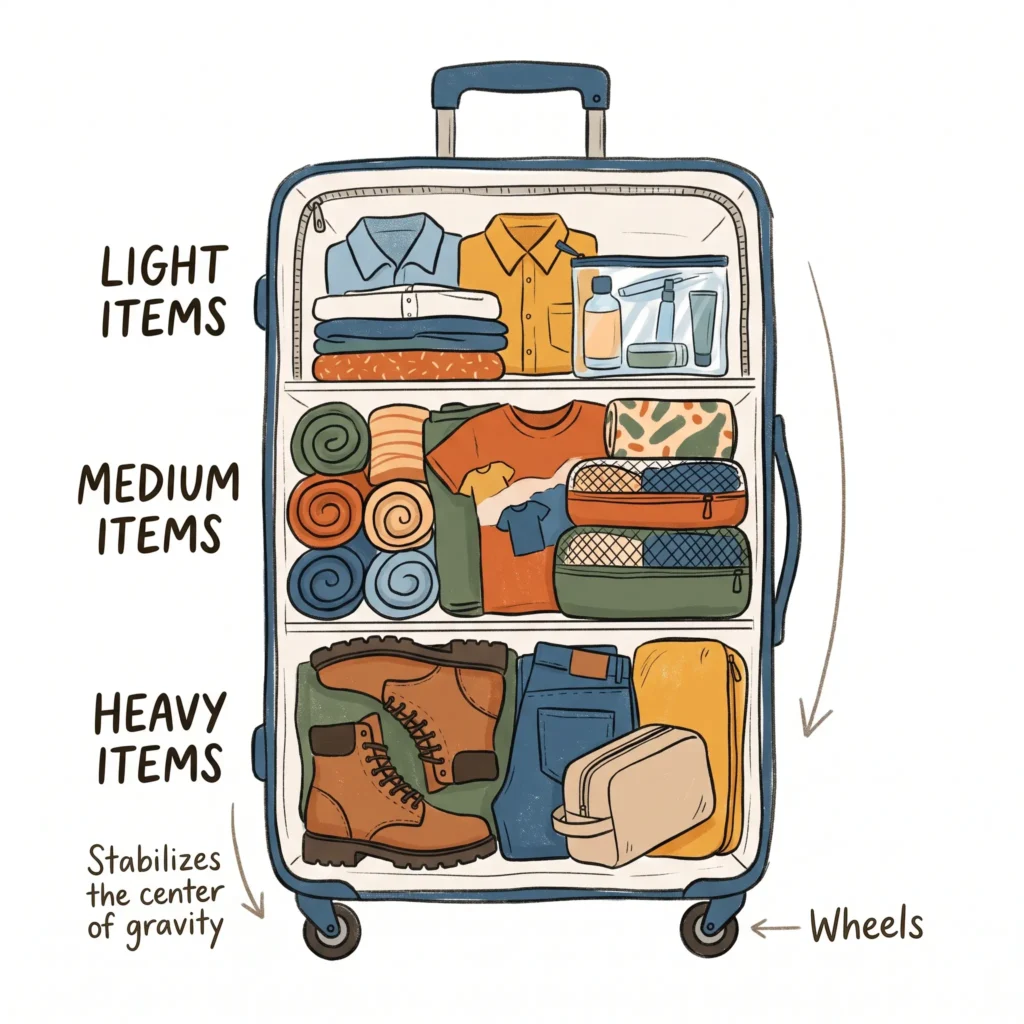
There’s more to mastering how to pack luggage than just folding your clothes. It’s also about thinking through how you distribute the weight. Most travellers do not pack carefully, throwing heavy items on top or toward the outer zippers. When the heaviest gear is located far from the wheelbase, the suitcase loses its natural center of gravity, causing the bag to constantly tip over and putting unnecessary strain on the spinner wheels. A grounded base keeps your bags upright so that you can breeze your way through busy airport terminals.
When planning how to pack luggage for international travel stress-free, the smartest approach is packing in balanced structural zones. Your heaviest items, like boots, heavy denim and substantial toiletry organisers, should be at the very bottom of your bag, right up against the wheels. Once you’ve set that anchor layer, fill in the center zone with your medium-weight layers, casual rolled clothes and tightly zipped compression cubes. Packing spare shoes with socks and small tech chargers maximises dead volume, keeps their shape, and protects valuable empty room.
Finally, understanding how to pack luggage while aligning the top section with standard packing guidelines ensures you pass security checks smoothly without damaging delicate clothes. For lighter cotton shirts, tailored pieces and your clear liquid travel kit, place them at the very top to avoid deep crushing and wrinkling during transport. Most importantly, by keeping your clearance items near the main zipper of your bag, if your luggage is flagged by border security for a routine physical inspection you can open and repack your bag in seconds without needing to dismantle your entire layout.
Final Checks & Costly Mistakes to Avoid
Run through this quick audit before you zip up your luggage to avoid check-in counter penalties, transit delays, and mid-flight panic.
Check 1: The Airport Scale Buffer
- Don’t: Rely on bathroom scales or estimate your luggage weight on thick hotel carpets.
- Do This: Use a handheld digital hook scale and stay at least 1 kg (2.2 lbs) under the airline limit. Check-in desk scales are rarely calibrated to match home scales.
- Last-Minute Save: If you are hovering right on the limit line, pull out your heaviest jacket and boots and wear them directly onto the flight.
Check 2: Lost Luggage Insurance (Cabin Split)
- Don’t: Pack all of your daily medication, charging cables, and clean clothes in the cargo hold.
- Do This: Pack a 24-hour survival kit in your personal cabin backpack with a complete outfit swap, essential chargers, and critical paperwork.
- Last-Minute Save: Before checking your luggage, take two clear photos on your phone: one of the bag’s exterior with its airline tag attached, and one of the packed contents inside. If the bag gets delayed, airline staff can identify it much faster with a visual reference.
Check 3: The Transit Shift Test
- Don’t: Leave loose dead air inside the bag assuming that just being underweight is enough.
- Do This: Pick up your zipped bag and give it a firm vertical shake. If items slide or thud against the corners, they will shift and crush delicate fabrics in rough transit.
- Last-Minute Save: Fill any empty hollows with a lightweight windbreaker, extra canvas tote, or an empty laundry bag to lock your clothing blocks snugly in place.
Check 4: Bag Identity & Zipper Integrity
- Don’t: Travel with unmarked, generic black suitcases and flimsy paper luggage tags that tear off on conveyor belts.
- Do This: Secure your compartments with a TSA-approved combination lock and attach a durable leather tag with concealed contact details.
- Last-Minute Save: Tie a strip of bright neon ribbon or tape around the top handle so you can spot your bag instantly on the baggage carousel and stop others from mistakenly grabbing it.
Frequently Asked Questions
1. How to pack luggage using rolling or folding for international travel?
Both work well together. Roll casual basics like tees and jeans to save space, and fold structured items so they stay crisp during long flights.
2. How much clothing do I need for long international travel?
When learning how to pack luggage for extended trips, pack just one week of mix-and-match clothes and plan a quick laundry stop.
3. Do compression cubes help when figuring out how to pack luggage?
Yes. They zip down bulky clothes to free up major space inside your suitcase, which is a lifesaver for busy international travel.
4. What should never go into checked luggage during international travel?
Keep passports, keys, essential pills, power banks, and electronics in your personal cabin bag so they stay safe during your flight.
5. How to pack luggage to avoid overweight airline fees?
Weigh your bag at home with a digital scale before leaving. If it is heavy, wear your bulkiest jacket and shoes to beat strict international travel limits.
6. Where should heavy gear go for smooth international travel?
A golden rule for how to pack luggage is putting shoes and heavy kits at the bottom near the wheels so the bag stays balanced and rolls easily.
7. How to pack luggage toiletries so they never leak during international travel?
Place plastic wrap under bottle caps before tightening them, then seal everything inside a zip pouch to handle cabin pressure drops.