On average, salespeople spend only a third of their working day speaking with buyers. The remainder of the time is consumed by low-value tasks: writing notes in the CRM, researching company backgrounds, sending follow-up emails manually, and moving deals through stages. Traditional automation was meant to solve this, but it mostly sent out stiff reminders that were blind to the real intent of buyers.
That’s where AI sales automation steps in and changes the game. Today’s AI tools don’t just spew out static rules. Instead, they analyze the context of the conversation, determine what the prospect actually wants, and compose personalized responses before the deal goes cold. It’s not about replacing sales reps, it’s about cutting through the admin work so they can focus on what actually makes money.
- 01. What Is Sales Automation?
- 02. How AI Transforms Sales Automation
- 03. Real-World Applications Across the Revenue Funnel
- 04. AI Sales Automation vs. Traditional Sales Automation
- 05. End-to-End AI Sales Automation Across the Deal Cycle
- 06. Top AI Tools Powering Modern Sales Automation
- 07. Clay
- 08. Apollo.io
- 09. Gong
- 10. HubSpot Sales Hub
- 11. How to Implement AI Sales Automation
- 12. Frequently Asked Questions
What Is Sales Automation?
Sales automation, fundamentally, is the software layer that removes repetitive operational tasks from a seller’s desk. Software handles those steps automatically behind the scenes, rather than requiring reps to manually copy contact details, log meeting dates or schedule follow-up sequences. The goal has always remained simple: cut down low-value administration so deal-makers can spend more time actually negotiating with clients.
That traditionally meant creating hard “if-this-then-that” rules across three core pillars:
- • Record Management: Syncing customer communication histories and pipeline stages behind the scenes without demanding manual data entry from the sales team.
- • Prospect Routing & Qualification: Route inbound leads to the correct Account Executive by predefined criteria such as company size, territory or specific website actions.
- • Outreach Scheduling: Triggering timely email sequences and reminder alerts so active deals never go cold from forgotten check-ins.
Traditional systems removed sheer volume from a seller’s checklist, but were fundamentally deaf to nuance. They could send an email at 9:00 AM on a Tuesday, but they couldn’t tell if the tone of the prospect had suddenly gone cold. And this is exactly where intelligence starts to replace static workflows.
How AI Transforms Sales Automation
Basic automation follows instructions, artificial intelligence interprets intent. Rather than just pushing a lead down a fixed sequence, modern sales engines use natural language processing and model prediction to eliminate the cognitive friction that traditional tools left behind. The software doesn’t need a human to go in and clean up data or assign status tags—it reads the room, it assesses engagement signals, and it actively prepares the next move.
This shift is not linear; it changes the daily sales execution in three different ways:
- • Autonomous Pipeline Hygiene: AI models listen to sales calls, email threads and calendar invites, automatically capturing action items and logging updates in the CRM – all without any human intervention.
- • Context-Driven Deal Intelligence: Machine learning detects subtle buying signals such as changes in executive tone or sudden activity on pricing documentation to flag deals that are at risk of stalling, instead of assigning scores based on form fills.
- • Hyper-tailored outreach at scale: Generative engines combine a prospect’s profile, recent company developments and past interactions to create authentic, highly contextualised messaging that reads like an advisor wrote it — not just a first name inserted into a static template.
These systems compound their advantage over time. Every answered objection, booked demo and closed opportunity further hones the underlying algorithm to help sales organisations respond to market shifts and close pipeline with surgical precision.
Real-World Applications Across the Revenue Funnel
Beyond basic automated sequencing, artificial intelligence operates as an active intelligence layer across every stage of the pipeline:
Predictive Prospect Intent
Instead of blasting cold databases, modern algorithms track hiring sprees, software installations, and executive shifts to pinpoint accounts entering an active buying window before they submit a form.
Dynamic Deal Forecasting
Replaces wishful quota estimations with historical win-loss patterns and pipeline velocity, giving sales leaders real revenue projections free from human bias.
In-Call Live Enablement
AI listeners monitor objections during live client meetings, instantly pulling up relevant product comparisons, battlecards, and ROI metrics right when the prospect raises a concern.
Continuous Competitive Tracking
Crawls public pricing updates, client review trends, and feature releases across competitors, automatically providing deal desks with timely talking points to protect contract margins.
AI Sales Automation vs. Traditional Sales Automation
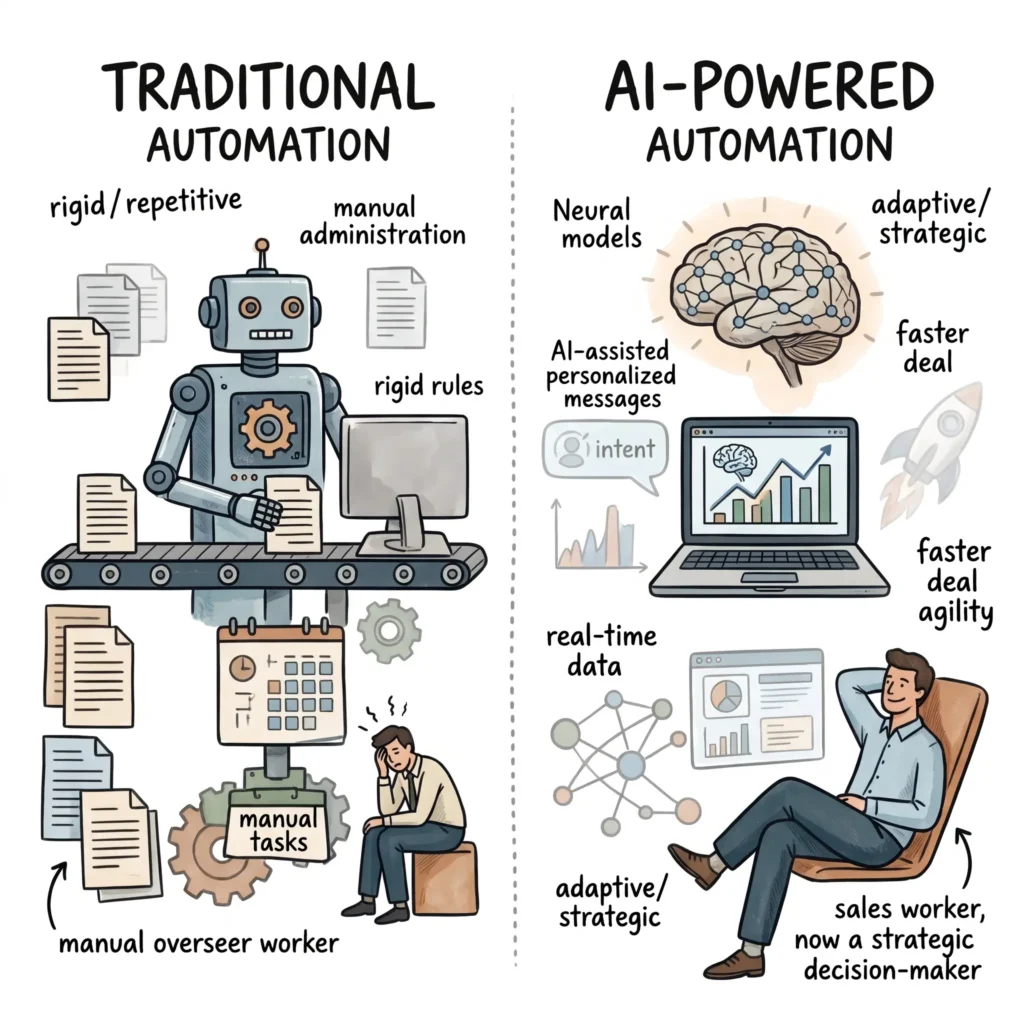
While both approaches aim to eliminate manual friction, they operate on completely different logic. Traditional automation executes rigid, predetermined instructions, whereas AI systems continuously interpret intent, tone, and behavioral patterns to guide the deal forward.
| Dimension | Legacy Sales Automation | AI-Powered Sales Automation |
|---|---|---|
| Operational Logic | Hardcoded triggers and static conditional rules. | Neural models that evaluate contextual nuances. |
| Data Ingestion | Structured form fields and fixed CRM properties. | Unstructured call notes, emails, and real-time market data. |
| Workflow Output | Repeats identical, pre-templated sequences. | Generates adaptive, customized recommendations and copy. |
| Deal Agility | Fires scheduled follow-ups regardless of buyer sentiment. | Detects hesitation or shifting priorities and pauses outreach. |
| Ideal Workload | Repetitive admin tasks and basic ticket routing. | Context-heavy deal prep, live coaching, and prospect research. |
| Human Role | Manual overseer handling every rule exception. | Strategic decision-maker reviewing generated intelligence. |
Traditional rule-based automation is not obsolete—it remains the backbone for simple reminders and routing. However, high-performing revenue teams treat rules as the baseline, using AI as the cognitive engine for fluid, high-stakes sales conversations.
End-to-End AI Sales Automation Across the Deal Cycle
Modern sales automation doesn’t operate in isolated pockets. Instead, it coordinates intelligence across all four critical phases of the sales cycle:
Account Discovery
- Deep Background Intel Aggregates corporate news, tech stack data, and executive profiles automatically.
- Dynamic Enrichment Verifies direct dials and buyer emails in the background without stale lists.
- Intent-Based Ranking Weights accounts by high-probability buying triggers rather than basic demographics.
Prospect Outreach
- Contextual Drafting Constructs cold messages around current prospect initiatives, not basic merge tags.
- Omnichannel Cadences Balances touches naturally across LinkedIn, email, and phone at optimal reply times.
- Pre-Call Dossiers Generates concise cheat sheets highlighting buyer pain points before discovery calls.
Call Execution
- Interactive Pitch Simulation Enables reps to roleplay tough pricing objections against adaptive AI bots.
- In-Meeting Cue Cards Surfaces case studies and competitor counters on screen the moment objections arise.
- Conversation Auditing Identifies talk-to-listen ratios and buyer sentiment shifts across recorded sessions.
Pipeline Velocity
- Instant Meeting Summaries Drafts mutual action plans and follow-up emails seconds after a call wraps.
- Automated CRM Sync Fills pipeline fields, updates deal stages, and logs next steps without manual typing.
- Early Churn & Stall Alerts Warns account executives when champion engagement drops before the deal is lost.
Top AI Tools Powering Modern Sales Automation
Deploying an effective AI sales engine requires platforms built for specific layers of the revenue stack. These four tools stand out as category leaders:
Clay
Clay is an intelligent data aggregator. Instead of a static database, it connects to over 50 data providers via waterfall enrichment to pull verified contact details, tech stack information and recent hiring moves. Its native AI agent, Claygent, can autonomously browse company websites, extract recent case studies and generate relevant opening lines for outreach emails before a rep even reviews the lead.
Apollo.io
Apollo has a huge proprietary B2B contact database, combined with end-to-end sequence automation. It has an inbuilt AI that helps reps write customised email copy, analyse reply sentiment to prioritise hot leads, and auto-score prospect accounts based on active buying signals.
Gong
Gong listens to live prospect calls, video demos and email threads to analyze buyer engagement in real time. Its natural language models identify when your customers change their tone, when there is deal hesitation around pricing, and when a competitor is mentioned. Gong does not use a rep’s positive pipeline estimates but instead leverages real conversation signals to predict deal outcomes.
HubSpot uses predictive AI throughout its core CRM. With Breeze AI, it automates pipeline hygiene by transcribing meetings, updating deal stages, and auto-logging buyer activity, without reps having to do it manually. It also tracks inbound inquiries to qualify and route leads to the right account executives within seconds.
How to Implement AI Sales Automation
Rolling out AI across an entire revenue org in one night is a sure way to create busted pipelines and burned-out sellers. The most successful teams treat automation as an incremental upgrade: they eliminate a specific manual bottleneck, validate the metrics, and then scale across the wider funnel.
The 7-Step Implementation Framework
Audit for Existing Deal Velocity: Track manual handoffs, data gaps, and where reps are losing active selling hours.
Target a Single Bottleneck: Choose one friction point that occurs repeatedly (such as meeting recaps, call notes, or lead enrichment).
Set Pre-AI Benchmarks: Determine existing task turnaround times and data completion rates to compare with future ROI.
Define Operational Guardrails: Establish strict data hygiene policies, sensitive data limits, and human approval gates.
Run a Focused Test Flight: Launch a 30-day pilot with a small group of senior reps on active pipeline deals.
Refine Prompts and Integrations: Adjust data inputs, custom prompts, and CRM sync triggers based on pilot feedback.
Scale and Continually Calibrate: Roll out across the team and audit algorithmic outputs quarterly as product priorities change.
Frequently Asked Questions
1. Will AI replace human sales reps?
No. AI automates routine admin tasks (data entry, research, call notes, etc.) so reps can focus on establishing confidence, handling objections, and closing deals.
2. What sets AI sales automation apart from conventional workflows?
Traditional tools are based on rigid “if-this-then-that” rules. AI determines the next best action in real-time, taking into account live context, buyer tone, and behavioral signals.
3. Can AI cold emails hurt domain deliverability?
Only if sent unescorted. High volume with generic copy triggers spam filters. Using AI for precise research and relevant, low-volume messaging protects sender reputation.
4. What AI sales tool should a lean team start with?
Start with an all-in-one platform like Apollo.io for lead sourcing and sequences, or integrate Clay if your main bottleneck is manual prospect research.
5. What’s the biggest mistake when deploying AI in sales?
Automating too many steps simultaneously. The best approach is to fix one specific friction point, like CRM note logging, and then scale it across the pipeline.
6. What is the easiest AI sales workflow to begin with?
Meeting summary and CRM note taking automation. It saves reps immediate administrative hours every week without any risk of customer-facing errors.
7. How do you prevent AI from spitting out false deal information?
Bring humans into the review loop. Require reps to verify high-stakes email drafts and critical CRM field updates before sending.